
Blog · Media Production
Planning a Combined Production: Briefing, Sequence and Handovers for Photo, Film and Sound

There is one sentence that almost always arrives too late in a combined production: “Oh, the video needs a voice-over as well.” By then the shoot day is fixed, the photos are selected, and suddenly the audio depends on a session nobody scheduled. Not because anyone was careless — but because three disciplines are meant to tell the same story while each needs something different before it can start.
A combined production of photo, film and sound rarely fails on the technology — it fails on the sequence. This article therefore covers the planning side: what belongs in a shared briefing, in which order the decisions come due, what does not go together on a single production day, and at which points material is handed from one discipline to the next.
In short
- One briefing for all three disciplines, not three separate ones. Every entry lands differently, but it lands everywhere.
- The audio track decides the length of the film. That is why the voice and music question belongs at the start, not at the end.
- Photo and film on the same day means the same people, the same wardrobe, the same lighting mood — otherwise the results will not sit together later.
- Flash and sound recording do not mix. If you plan both on one set, you plan them one after the other.
- Collect consent once, for every medium and for the full intended reuse — not three times after the fact.
- Name the handover points in advance: who delivers what to whom, in which format, by when.
- S3PS brings the three studios together at one address, Westendstraße 177 in Munich. A combined project is planned and quoted individually.
One Briefing, Three Disciplines – What Belongs In It
The most common planning mistake is not a missing briefing but three separate ones. Photo gets a shot list, film gets a concept, sound gets a script — and nobody notices that the three assume different audiences.
Write one document instead, one that all three read. Every entry in it matters to every discipline, just differently:

Two entries are almost always forgotten, and both are expensive:
The channel it will finally run on. A LinkedIn post, a trade-fair loop and a hero video on the homepage are three different productions — in length, aspect ratio and audio mix. Name the channel only in post-production and you pay for the edit twice.
The intended period of use. It governs the consent forms, the music licence and how timeless wardrobe and look have to be. A film meant to run for three years does not tolerate seasonal fashion.
The Sequence Decides the Cost
The three disciplines are not ready to start at the same moment. Each needs a prior decision that is made elsewhere — and rolling the chain up from the back produces waiting time.
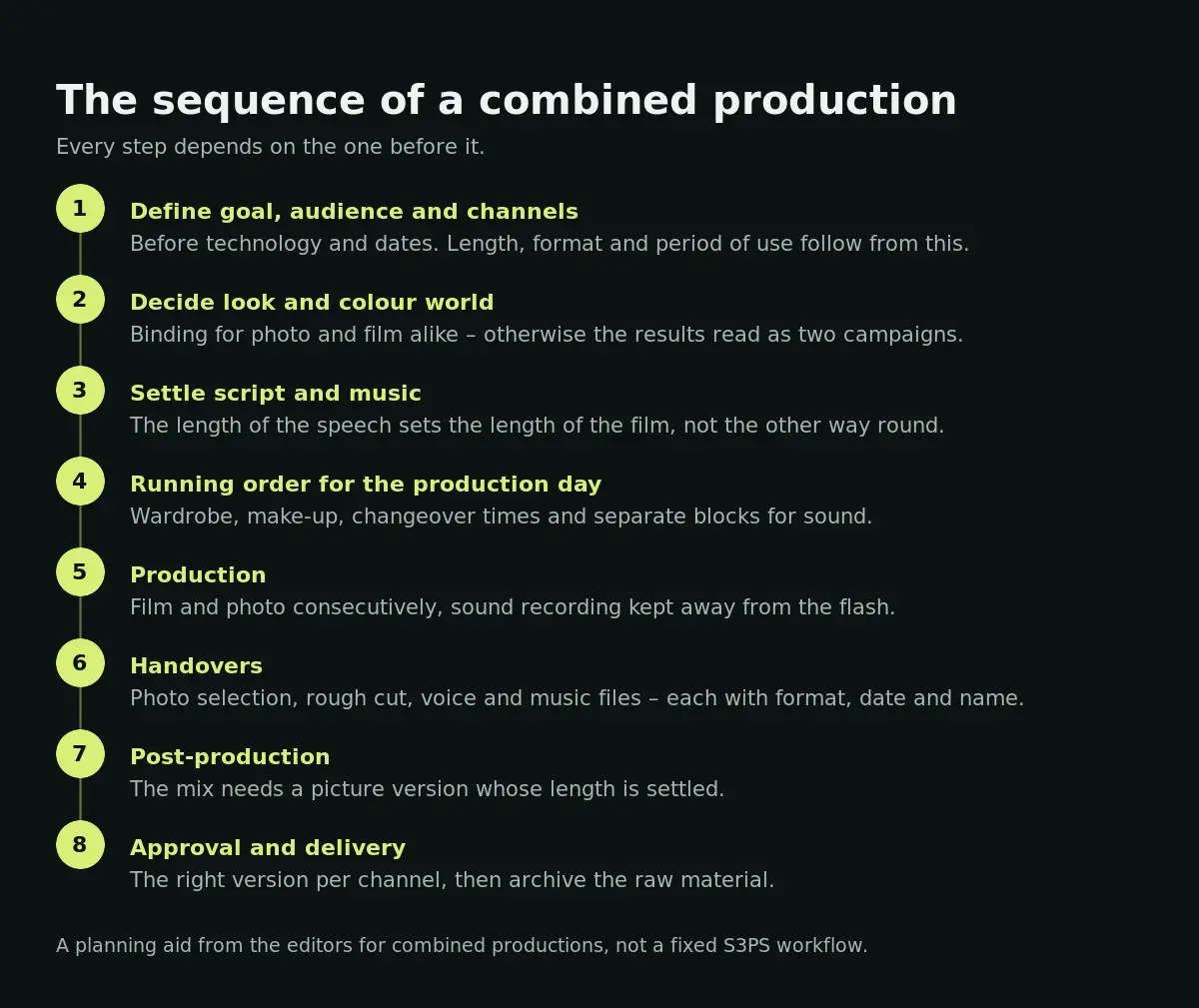
The most important point sits at position three: language and music belong at the front. The length of a voice-over script determines the length of the film, not the other way round. Edit first and dub afterwards and you either cut the script until it rushes or stretch pictures until they stall. Both are audible and visible.
For the photos the opposite applies. They are the most flexible element and therefore often scheduled last. That is exactly wrong when the same people are meant to appear on camera and in front of the lens — because then the photo session depends on the shoot day, not on the picture desk’s calendar.
What Photo, Film and Sound Need From Each Other
Three dependencies that regularly slip through planning:
- Film needs from sound the final script and the decision whether music sits under the voice. Both change the rhythm of the edit.
- Photo needs from film the colour world and the lighting mood. If the film is graded warm and contrasty while the photos are neutral and bright, they will later read as two different campaigns.
- Sound needs from both the final length per channel. A voice recording written for 90 seconds cannot be trimmed to 30 without losing the sense — whereas a second version is recorded quickly within the same studio session.
From this follows a practical rule: record several lengths in the same voice session if several channels are planned. The variant costs a few minutes during the session and a separate session afterwards.
The Shared Production Day: What Does Not Go Together
If photo and film happen on the same day, it is worth looking at the conflicts before the running order is fixed:
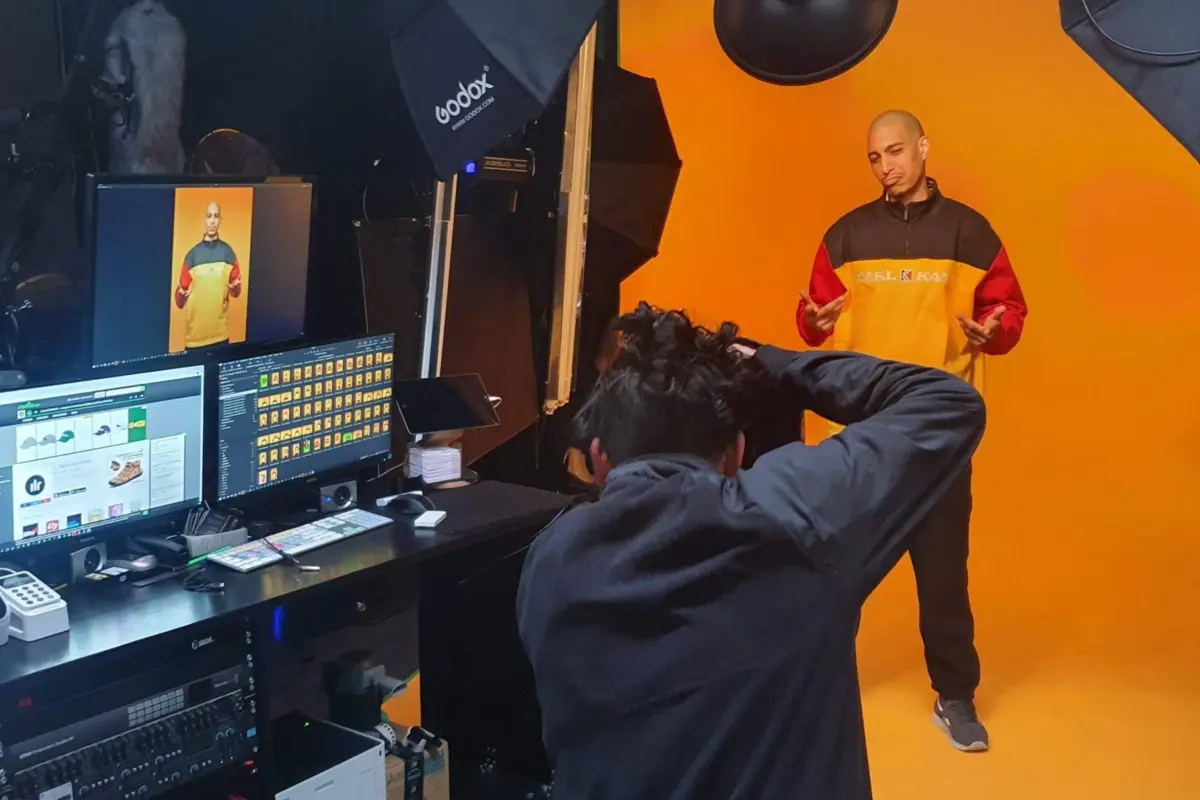
- Flash and sound recording are mutually exclusive. Studio strobes make noise, and the recycle time lands in the middle of a sentence. Either sound or flash — consecutively, not in parallel.
- Continuous light and flash need to be matched. Anyone switching between film and photo should schedule time for the change instead of treating it as a quick move.
- Wardrobe changes cost more time than expected, and every change breaks the link between photo and film. If both media are to show the same person in the same outfit, that has to be in the running order.
- Make-up does not last indefinitely. A shoot day followed by a photo block needs a scheduled touch-up, not a spontaneous one.
- People get tired. The last two hours of a combined day rarely deliver the best material. Put the most important subjects at the front.
One principle applies specifically to the sound side: production sound and studio voiceovers serve different purposes. Good production sound depends on suitable microphone placement on set. A separate voiceover can be recorded in controlled studio conditions; both should be planned in advance.
Handovers: Who Delivers What to Whom, and in Which Format
The point where combined projects actually stall is rarely the recording — it is the handover in between. Four places deserve an explicit agreement:
- Photo selection to retouching. Who selects, by when, and how many images go into retouching? Without a named decision-maker, retouching waits for an approval nobody is allowed to give.
- Rough cut to the audio mix. The mix needs a picture version whose length will not change again. Every later trim makes the mix new.
- Voice and music files to the edit. Agree format and naming beforehand — a file called “final_v3_new” costs more time than an extra export.
- Approved version to the channel owners. Whoever publishes needs the file in the form the channel requires, not the master.
Each of these points needs three things: a format, a date, a name. Leave one of them out and that is exactly where the delay appears.
Settle Consent and Rights Once, Not Three Times
As soon as recognisable people are involved, Section 22 of the German Act on Copyright in Works of Fine Art and Photography applies to the distribution of portraits: in principle they may only be distributed or publicly displayed with the consent of the person depicted (statute text).
For a combined production that means, practically:
- One consent form covering every medium. Photo, moving image and voice. Hand out three separate forms and you will get two of them back.
- Name the reuse explicitly. “We are filming today” does not cover an advertising campaign next year. Write the channels and the period into the form.
- Do not forget the voice. A voice recording is a separate performance with its own scope of use — that applies to booked voice talent just as much as to employees recording a statement.
Music follows its own route: using third-party music requires a licence. GEMA treats use on the internet as its own case (GEMA: music use on the internet). The alternative is purpose-made music or your own audio logo — the usage rights, channels and licence term should still be agreed explicitly.
What a Combined Production Delivers – and for Which Channel
A combined production delivers more than “photos and a video”. It is worth writing the deliverables list before the production, not after:
- Photos in the crops the channels need — landscape for the website, portrait for social media, cut out for the shop.
- The main film at the length that belongs on the homepage, plus at least one short version for social media.
- An audio track that works on its own — as a podcast episode, a phone message or an audio logo, depending on the project.
- Subtitles for the video versions. A large share of the audience watches without sound.
- Raw material and an archive version. If you want a new edit in two years, you need the original, not the export.
Which formats suit which channel is described in detail in the article planning video formats.
Common Mistakes – and How to Avoid Them
- Writing three separate briefings. One document that all three read.
- Planning the voice-over last. The script sets the film length, not the other way round.
- Producing photo and film without a shared colour world. Fix the look beforehand.
- Scheduling sound and flash in parallel. Plan them consecutively, with a buffer.
- Leaving wardrobe changes out of the running order. Every change costs continuity.
- Collecting consent per discipline. One form for every medium and the reuse.
- Agreeing handovers without a name and a date. Format, date, name — always all three.
- Naming the channel only in post-production. Then the edit gets paid for twice.
- Recording only one script length. Variants cost minutes in session and a session later.
- Not backing up the raw material. The export is a delivery, not an archive.
FAQ – Frequently Asked Questions
Do I have to book all three services together? No. Photo, film and sound can be commissioned individually — each of the three studios works independently. Joint planning pays off when the results are meant to appear together.
In which order should I enquire? With the goal and the channel, not with the technology. Once it is clear what should run where in the end, the rest of the planning largely follows.
Can photo and film happen on the same day? In principle yes, and for a consistent visual language it is the better solution. But it has to be in the running order: changeover times between continuous light and flash, wardrobe, a make-up touch-up and separate blocks for sound.
Why does the voice-over script have to be final before the edit? Because the length of the speech determines the length of the film. Edit first and dub afterwards and one of the two will not fit — either the script rushes or the pictures stall.
Do I need separate consent for each medium? One form is enough if it explicitly covers photo, moving image and voice and names the intended reuse by channel and period. Separate forms are the most common reason for missing approvals.
What about music in the video? Third-party music requires a licence. Either the licence is cleared before publication, or purpose-made music or your own audio logo is produced instead.
How long does a combined project take? That depends on scope, the number of shoot days and the rounds of approval. A binding answer belongs in a quote, not in a blog post — ask for it with the key facts of your project.
What does it cost? The three studios list their services separately; a combined production is quoted individually. State the goal, channels, dates and the number of people involved in your enquiry and it can be calculated concretely.
Do I get the raw material? That is a question of scope and belongs in the agreement. Settle it before the production, not after delivery.
Can employees appear instead of models? Yes, and it often reads as more credible. Two things come with it: voluntary, separately granted consent and enough time — people who are not used to being on camera need more takes.
Your Project at S3PS
Once the goal, the channels and a rough date are settled, the next step is a project enquiry — not an instant booking, because a combined production has to be agreed in advance. State the goal and core message, the planned channels, your preferred dates, the number of people on camera, whether voice or music is needed and how long the material should run.
The three studios work together under the S3PS roof at one address — more about that on the About us page. For an overview of what photo, film and sound achieve together, see the article Photo, Video and Audio from One Source.
Planning a production that combines photo, film and sound? A combined production is agreed in advance – there is no instant booking for it. Email [email protected] or call +49 (0)89 78796606. All contact details and directions are on the About us page. For individual services you can reach the studios directly: PM STUDIOS, 3DMS and SOUNDSTARSTUDIOS.
Location and Getting There
The three studios work at one address, Westendstraße 177 in Munich’s Westend district, a few minutes’ walk from the Westendstraße underground station. For a combined production that is the practical advantage: photo, film and sound sit in the same building, so material does not have to be moved.
- Address: Westendstraße 177, 4th floor, 80686 Munich, Germany
- Underground: U4 or U5 to Westendstraße
- Tram: line 18 to Westendstraße
- Bus: 130 or 157 to Westendstraße, 62 to Elsenheimerstraße
- By car: there are no dedicated customer parking spaces – please look for public parking nearby and allow time for delivering equipment
Plan your route · MVG timetables